A scar—the medical term used here for what people commonly call a scar—is tissue that forms as the skin repairs itself after an injury. When skin damage reaches a certain depth, especially when it involves the dermis, the body starts a repair process and fills the wound with new connective tissue. The result of this repair is a scar.
Surgical incisions, burns, scalds, abrasions, cuts, infections, and other injuries can all leave scars of varying severity. The presence of a scar means that the body has gone through a process of injury repair. It helps close the wound, restore the skin barrier, reduce the risk of infection, and allow the body to complete healing as quickly as possible.
Normal skin is made up of the epidermis, dermis, and subcutaneous tissue, and also includes hair follicles, sweat glands, sebaceous glands, blood vessels, and nerves. If a superficial injury affects only the epidermis, it can usually heal through regeneration of epidermal cells, and the likelihood of leaving an obvious scar is low. For example, after a minor abrasion or superficial break in the skin, there may only be temporary redness, darkening, or lightening after healing.
If a wound extends into the dermis, it is difficult for the skin to fully restore its original fine structure. The body mobilizes fibroblasts to produce collagen and extracellular matrix, filling in the damaged area. This process allows the wound to heal, but the newly formed tissue differs from the original normal skin, so a scar remains.
Differences between scars and normal skin
A scar can be understood as a “patch” after skin repair. It can close the wound and restore a certain degree of strength, but its structure is different from normal skin.
In normal skin, collagen is arranged in a relatively orderly way, elasticity is better, and accessory structures such as hair follicles, sweat glands, and sebaceous glands are present. In scar tissue, collagen is often arranged more densely and more irregularly, elasticity is poorer, and the color, thickness, and texture may also change.
Therefore, common scar features include: local skin becoming red, darker, or lighter; skin becoming firm, thick, or shiny; the surface becoming raised or depressed; tightness, itching, or pain; and, in severe cases, pulling on surrounding tissues, affecting joint movement, facial expression, or body function.
Some scars gradually become lighter, softer, and flatter over time; some continue to thicken and may even extend beyond the original wound margins, developing into pathological scars.
Different stages of wound healing
Wound healing is a continuous biological process and does not end completely once the surface appears healed. It can generally be divided into three main stages:
Hemostasis and inflammatory phase
After the skin is injured, the body must first stop the bleeding. Platelets rapidly aggregate and form a blood clot to seal the damaged blood vessels. At the same time, platelets and local tissues release various signaling substances that attract inflammatory cells into the wound.
These inflammatory cells remove bacteria, necrotic tissue, and foreign material, creating conditions for subsequent repair. This stage may appear as local redness, swelling, warmth, and pain. Moderate inflammation helps wound repair, but excessive inflammation or persistent infection increases the risk of scar overgrowth.
Proliferation and filling phase
After entering the proliferative phase, fibroblasts become highly active. They produce collagen, fibronectin, and other extracellular matrix components to fill the wound defect.
At the same time, new blood vessels grow into the wound, providing oxygen and nutrients to the repairing tissue. During this stage, the wound may look relatively red because there are abundant new blood vessels and active local metabolism.
If fibroblasts are overactive and produce too much collagen, the scar is more likely to become thick, firm, and raised. Hypertrophic scars and keloids are both closely related to excessive repair during this stage.
Maturation and remodeling phase
After the wound surface has healed, repair inside the skin continues. Collagen gradually reorganizes, some excess tissue is absorbed, the number of blood vessels decreases, the scar color slowly fades, and the texture gradually softens.
This process is called scar maturation or scar remodeling. It usually takes several months, and in some people it may take more than a year. Many early scars that are red and firm improve naturally over time.
Normal scars
A normal scar is a common result after wound healing. It is generally confined to the original wound area. Early on, it may be red, slightly firm, and mildly raised; over time, it gradually becomes lighter in color, softer, and flatter.
For example, after an ordinary surgical incision heals, it may initially appear as a pink or red linear scar. After several months, the color gradually becomes closer to the surrounding skin tone, the thickness decreases, and the scar feels softer. Although the mark may still be visible on close inspection, it does not show obvious overgrowth and does not continue to enlarge.
Normal scars usually do not require excessive treatment. The focus is on proper care, sun protection, reducing tension on the wound, and using supportive measures such as silicone gel or silicone sheets under a doctor’s guidance.
Hypertrophic scars
A hypertrophic scar is one common type of pathological scar. It is characterized by a scar that is noticeably raised, red, and firm, sometimes with itching or pain, but it generally remains confined to the boundaries of the original wound.
It is common after surgical incisions, burns, and traumatic injuries, and is especially likely to occur in areas with greater skin tension, such as the front of the chest, shoulders, upper arms, and near joints.
Hypertrophic scars may improve on their own to some extent. Over time, they may gradually become flatter, softer, and lighter in color. However, if they affect appearance or function, or if itching and pain are significant, they can be improved with treatments such as medication injections, laser therapy, pressure therapy, silicone therapy, or combined treatment with surgery.
 View full-size image
Combined-treatment outcome
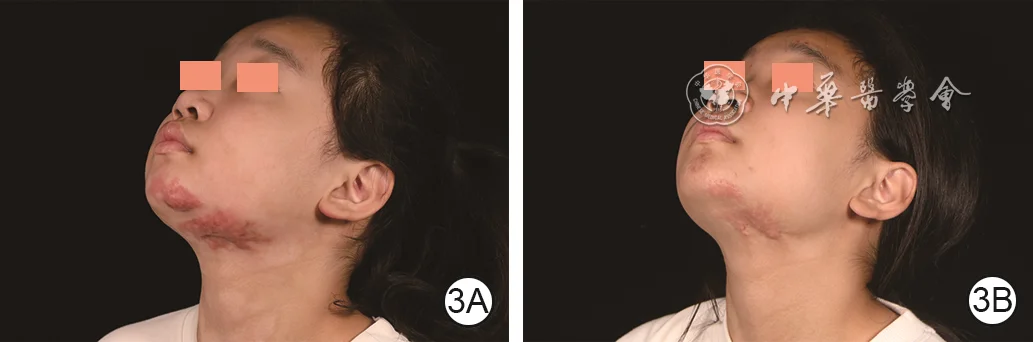
A mandibular hypertrophic scar was treated with pressure therapy combined with narrow-band intense pulsed light; after nine months, scar flatness improved and vascular congestion decreased.
- 3ABefore treatment, the hypertrophic scar is markedly raised above the skin surface with prominent vascular congestion.
- 3BAfter nine months of treatment, scar flatness has improved and vascular congestion has decreased.
Image source:Zeng Y, Wang C, Lin HY, et al. Clinical efficacy of pressure therapy combined with narrow-band intense pulsed light for hypertrophic scars. Chin J Burns Wounds. 2026;42(4):324–331. DOI: 10.3760/cma.j.cn501225-20251211-00518
Keloids
A keloid is a more stubborn type of pathological scar. Its typical feature is that it extends beyond the original wound boundaries and grows into the surrounding area like a lump. It may continue to enlarge and may be accompanied by itching, pain, stinging, or a feeling of pulling.
Keloids commonly occur on the earlobes, jawline, front of the chest, shoulders and back, and upper arms. Some people may also develop keloids after ear piercing, acne, or minor trauma.
Keloids are related to individual constitution, genetic factors, skin color, local inflammation, and skin tension. They have a relatively high risk of recurrence and may grow again after simple excision, so comprehensive treatment is usually needed, such as surgery combined with radiotherapy, steroid injections, pressure therapy, and laser therapy.
Some People Are More Prone to Scarring
Everyone’s skin repair response is different. With wounds of the same size, some people heal with very faint marks, while others form obvious scars. This is related to multiple factors.
People with darker skin are more prone to pathological scars, especially keloids. The incidence of keloids is relatively higher among Black people, Asians, and Hispanic people. This may be related to more active melanocytes and a stronger inflammatory response in the skin. After pigment cells are stimulated, local inflammation and repair responses may become more pronounced, thereby increasing the risk of scar overgrowth.
Genetic factors are also important. Keloids show a clear familial tendency. In some families, multiple members are prone to developing keloids. If a parent or sibling is prone to keloids, a person’s own risk of developing pathological scars increases. However, genetic factors alone do not determine the outcome; the wound location, depth of injury, infection, tension, and wound-care methods also jointly influence the final appearance.
Age also affects scarring. Pathological scars are more common in adolescents and young adults. At this stage, body tissues are growing actively, fibroblasts are active, collagen synthesis is strong, and the response to trauma is also stronger. Young people’s wounds heal quickly, but when repair is excessive, hypertrophic scars are also more likely to develop.
Wound Location Affects Scarring
Skin tension varies in different parts of the body, and the risk of scarring also varies. Areas such as the front of the chest, shoulders, upper arms, jawline, and earlobes are more likely to develop hypertrophic scars or keloids.
Areas such as the eyelids, forehead, external genitalia, palms and soles, cornea, and mucous membranes have a relatively lower likelihood of developing obvious pathological scars.
Skin tension is a very important factor. If an incision is parallel to the skin’s natural tension lines, the wound is subjected to less pulling, and the scar is usually finer. If an incision is perpendicular to the tension lines, or is located in an area that frequently moves or stretches, the scar is more likely to become wider and thicker.
This is also why plastic surgeons, when planning incisions, try to follow the skin’s natural texture and tension lines, so that the mark left after wound healing is less noticeable.
The Way a Wound Is Managed Affects Scarring
Wound care and medical management have a major impact on scarring. Infection, retained foreign material, inadequate debridement, sutures that are too tight, poor wound edge alignment, repeated friction, and premature pulling can all stimulate excessive scar growth.
The longer a wound takes to heal, the higher the risk of excessive scar formation. If a wound surface heals smoothly within a relatively short time, the scar is usually milder; if healing is delayed for a long time, or the wound repeatedly breaks down or becomes infected, the incidence of pathological scarring rises significantly.
Therefore, deep wounds, contaminated wounds, burns and scalds, animal bites, and postoperative incisions with abnormal redness, swelling, or discharge should all receive timely medical care. Proper wound management in the early stage is an important step in reducing scarring.
After a Wound Heals, It May Still Be Red, Itchy, and Firm
Many people find that after a wound has closed, the local area remains red, itchy, and firm. This is relatively common in the early stage of scar formation.
Redness is usually related to an abundant supply of new blood vessels. During wound repair, a large blood supply is needed, so early scars may appear reddish or pink. Firmness is related to collagen deposition. After fibroblasts produce large amounts of collagen, the local tissue becomes thicker and tighter. Itching may be related to nerve repair, inflammatory factors, and local tension.
If these signs gradually lessen, they are generally part of the scar maturation process. If itching and pain continue to worsen, and the scar becomes thicker and larger in area, medical attention should be sought as early as possible.
Common Scar Q&A
Will a wound always leave a scar after it heals?
Whether a scar remains depends mainly on the depth of the wound.
Superficial injuries that affect only the epidermis usually do not leave obvious scars. Injuries that reach the dermis have a significantly higher likelihood of leaving a scar. The deeper and larger the wound, the more severe the infection, and the slower the healing, the more likely the scar is to be noticeable.
Acne follows a similar principle. Mild comedones usually do not leave scars. Severe inflammatory acne, nodulocystic acne, or repeated squeezing that causes dermal injury may leave depressed acne pits or hypertrophic scars.
Can scars disappear completely?
True scars that have already formed are difficult to restore completely to the original normal skin. This is because the original skin structure has been replaced by fibrous tissue, and structures such as hair follicles, sweat glands, and sebaceous glands usually cannot regenerate completely.
However, many scars can be improved. Through natural maturation over time or through medical treatment, the color can become closer to the surrounding skin, and itching and pain can also be reduced.
Common treatment options include silicone gel, silicone sheets, pressure therapy, corticosteroid injections, laser treatment, surgical revision, radiation therapy, and combined drug therapy. The specific approach should be determined according to the scar type, location, duration, and individual constitution.
 View full-size image
Long-term multimodal intervention
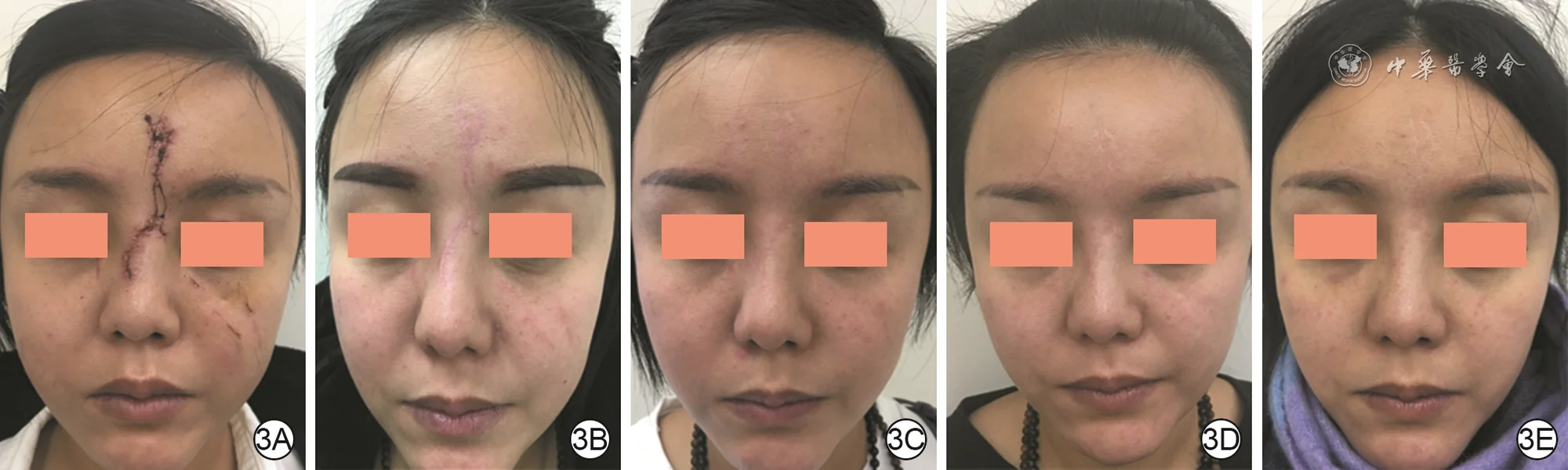
Early adult forehead and nasal wounds underwent long-term multimodal tissue remodeling with oral medication, local injection, ion-beam treatment, and fractional carbon dioxide laser; at 41 weeks after injury, the treated scars were nearly imperceptible.
- 3AAt two weeks after injury, a vertical healing wound is visible across the forehead and nose, with several smaller facial wounds.
- 3BAt 17 weeks, after oral medication, local injection, and two energy-based treatments, wound appearance has improved and a third treatment is administered.
- 3CAt 25 weeks, eight weeks after the third energy-based treatment, the scars are markedly improved and a fourth ion-beam treatment is administered.
- 3DAt 33 weeks, eight weeks after the fourth ion-beam treatment, the forehead and nasal scars show further improvement with fine residual traces; a fifth ion-beam treatment is administered.
- 3EAt 41 weeks, eight weeks after the fifth ion-beam treatment, the scars in the treated area are nearly imperceptible.
Image source:Liu W. Application of interventional tissue remodeling strategy in scar prevention and treatment. Chin J Burns Wounds. 2025;41(4):325–332. DOI: 10.3760/cma.j.cn501225-20250102-00004
How can ordinary people reduce scar formation?
The key to preventing scars is to help the wound heal as quickly, smoothly, and with as little inflammation as possible.
After an injury, keep the wound clean and avoid infection. Do not repeatedly scratch or pick at scabs, do not squeeze pimples, and do not try to manage deep wounds on your own. Surgical incisions should have dressing changes and follow-up visits as instructed by the doctor. Wounds in areas that move should be protected from pulling or tension; if necessary, use wound-closure strips or other tension-reducing measures.
After the wound has closed, pay attention to sun protection. Ultraviolet light can worsen pigmentation and make the scar darker. For scars that are prone to becoming raised, silicone gel, silicone sheets, pressure therapy, and other methods may be used under a doctor's guidance.
If you are prone to keloids, you should be cautious about ear piercing, tattoos, and non-essential cosmetic surgery. If a small wound occurs, standardized care should also be started earlier.
Which scars should be seen by a doctor early?
If a scar is only mildly red, gradually fading, and causes no obvious discomfort, it can be observed at first.
If a scar continues to become thicker, harder, or larger; is clearly itchy, painful, or stinging; extends beyond the original wound area; or is near a joint and affects movement, it is advisable to see a plastic surgeon or scar specialist as early as possible.
Scars on the face, neck, chest, and other areas that affect appearance; large scars formed after burns or scalds; obvious raised scars after a surgical incision has healed; and firm, lump-like overgrowths after ear piercing or acne are also appropriate for early evaluation.
The earlier pathological scars are treated, the easier they usually are to control. If a scar becomes very thick or extensive, treatment may take longer and the risk of recurrence may be higher.
References
- New Scarology, edited by Huiyuan Li, Kaihua Lu, and Shuzhong Guo, Fourth Military Medical University Press.
- Monstrey S, et al. Updated scar management practical guidelines: non-invasive and invasive measures. J Plast Reconstr Aesthet Surg. 2014;67(8):1017–1025. PubMed
- Gold MH, et al. Updated international clinical recommendations on scar management: part 2—algorithms for scar prevention and treatment. Dermatol Surg. 2014;40(8):825–831. PubMed
- Zeng Y, Wang C, Lin HY, et al. Clinical efficacy of pressure therapy combined with narrow-band intense pulsed light for hypertrophic scars. Chin J Burns Wounds. 2026;42(4):324–331. DOI: 10.3760/cma.j.cn501225-20251211-00518
- Liu W. Application of interventional tissue remodeling strategy in scar prevention and treatment. Chin J Burns Wounds. 2025;41(4):325–332. DOI: 10.3760/cma.j.cn501225-20250102-00004