The skin repair process after a burn is often more complex than that of an ordinary incision, because burns may cause large areas of skin loss, dermal injury, destruction of skin appendages, and damage to blood vessels and nerves.
Burn scars change over a long period. For example, after the wound surface has healed, collagen remodeling within the skin may continue for months to years. Early scars may become increasingly red and firm, and then gradually enter the maturation phase. Without early management, scars may continue to proliferate and may even pull on joints, affect movement, and cause deformity.
The goal of burn scar management is not only to make scars fade. It also includes reducing itching and pain, controlling hypertrophy, preventing contracture, protecting joint range of motion, improving appearance, restoring function, and reducing the difficulty of later reconstruction.
Common manifestations of burn scars
The most common manifestations of burn scars include changes in color, changes in texture, increased thickness, and restricted movement.
Early scars are often red, pink, or dark red, with a shiny surface and a firm feel to the touch. Some patients experience itching, tingling, burning, and tightness, with symptoms worsening when clothing rubs against the area or when the weather changes. As collagen deposition increases, the scar may gradually become raised, forming a hypertrophic scar.
If the burn is deep or covers a large area, the scar may shrink and form a contracture scar. Mobile areas such as the neck, armpits, elbows, hands, knees, and ankles are especially vulnerable. Mild contracture presents as a pulling sensation; in severe cases, it may lead to inability to fully straighten a joint, difficulty raising the arm, limited ability to make a fist, restricted head turning, or an abnormal gait.
Burn scars may also be accompanied by hyperpigmentation or hypopigmentation. Dark scars can make the skin appear uneven, while pale scars may appear white or shiny. Some areas of deep burns may also develop dry skin, reduced sweating, abnormal sensation, and repeated breakdown.
Burn scars are prone to hypertrophy and contracture
Burn wounds often have a large extent, marked inflammation, and a long healing time. The slower the wound heals, the higher the risk of scar hypertrophy. Second-degree and third-degree burns often damage the deep dermis and skin appendages, so the body can complete repair only through substantial collagen deposition.
After a burn, fibroblasts and myofibroblasts remain active. Fibroblasts produce collagen and extracellular matrix, while myofibroblasts have contractile ability and gradually reduce the wound size. Moderate contraction helps the wound close; when contraction is excessive, the scar becomes shorter, harder, and tighter, eventually forming a contracture.
Skin tension and joint movement can also worsen the problem. Areas such as the armpit, neck, fingers, the front of the elbow, and the back of the knee are repeatedly pulled during daily movement, so scars tend to contract along the direction of force. Burn scars in children are also affected by growth and development. Normal skin can stretch as the body grows, but scar tissue has poor elasticity and can gradually cause pulling and deformity.
Importance of early wound care
Burn scar management begins during the wound stage. The more standardized the wound care, the lower the later risk of scarring.
Superficial burns are usually managed mainly by protecting the wound, preventing infection, and promoting epithelial regeneration. Deeper burns require a physician to assess whether debridement, dressing changes, tangential excision, skin grafting, or other coverage methods are needed. If a wound remains unhealed for a long time, the inflammatory response and collagen deposition increase, making thick, hard scars more likely to form later.
Infection control is very important because infection prolongs healing time, stimulates persistent inflammation, and makes scars more likely to become hypertrophic. If a burn wound develops obvious redness and swelling, drainage, an unpleasant odor, worsening pain, or fever, medical attention should be sought as early as possible.
For deep burns, timely wound coverage is an important strategy for reducing scarring. For wounds that can heal on their own, a favorable healing environment should be created as much as possible. For wounds that are unlikely to heal on their own, the physician may consider skin grafting or flap coverage to shorten the time the wound is exposed and reduce the later risk of scarring and contracture.
Controlling hypertrophy after wound closure
After wound closure, burn scars enter a critical management period. At this stage, the scar may begin to become red, firm, itchy, and thickened. The more actively it is controlled early on, the easier later treatment will be.
Silicone gel and silicone sheets are among the commonly used methods. They can be applied to the surface of a closed scar. During use, the skin should be kept clean, and they should not be used on unhealed wounds or infected areas.
Pressure therapy is also an important method in burn scar management. Elastic garments, pressure sleeves, pressure gloves, face masks, neck collars, and similar devices can provide continuous pressure to scars, helping to suppress excessive overgrowth and promoting scars to become flatter and softer. Pressure therapy usually requires long-term adherence, and a professional should assess whether the pressure is appropriate.
 View full-size image
Combined-treatment outcome
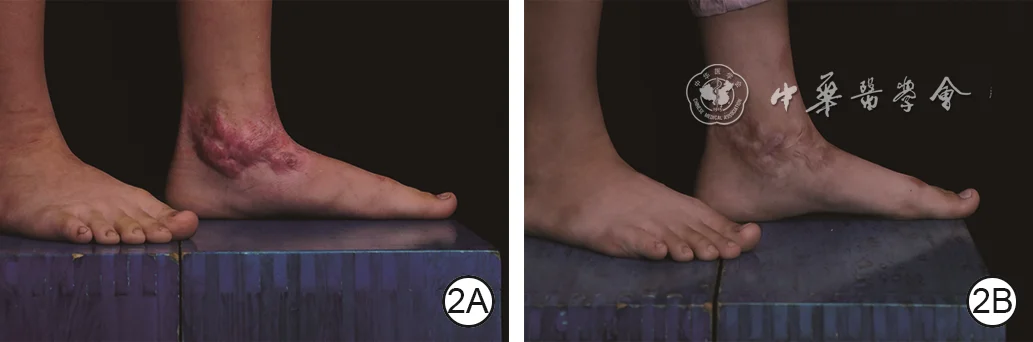
A hypertrophic scar of the left ankle was treated with pressure therapy combined with narrow-band intense pulsed light; after nine months, scar thickness and vascular congestion were reduced.
- 2ABefore treatment, the scar is markedly raised with prominent vascular congestion.
- 2BAfter nine months of treatment, scar thickness and vascular congestion have decreased.
Image source:Zeng Y, Wang C, Lin HY, et al. Clinical efficacy of pressure therapy combined with narrow-band intense pulsed light for hypertrophic scars. Chin J Burns Wounds. 2026;42(4):324–331. DOI: 10.3760/cma.j.cn501225-20251211-00518
Sun protection is equally important. Newly formed skin after a burn is sensitive to ultraviolet light and is prone to hyperpigmentation. When going outdoors, the area should be covered and sunscreen products should be used to reduce darkening of the scar and worsening color mismatch.
Itching and Pain Management
Itching in burn scars is very common and may be related to nerve repair, inflammatory factors, dry skin, scar tension, and local vascular changes. When itching is severe, patients may scratch repeatedly, leading to skin breakdown, infection, and worsening scarring.
Basic care during scar treatment is very important. This care includes moisturizing, avoiding hot-water irritation, reducing friction, wearing soft clothing, and so on. Moisturizing can improve dryness and tightness and reduce itching. If itching is significant, the doctor may use antihistamines, topical medications, laser therapy, or intralesional scar injections depending on the situation.
Pain, stinging, and burning sensations may be related to scar hypertrophy, nerve sensitivity, deep adhesions, or traction on joints. When pain is pronounced, evaluation is needed to determine whether the scar is in an active hypertrophic phase and whether neuralgia, ulceration, or infection is present. Treatment may combine medication, laser therapy, injections, rehabilitation training, and psychological support.
Rehabilitation Training: Preventing Functional Impairment
In the long-term management of burn scars, rehabilitation training is just as important as appearance-focused treatment. Especially in areas such as the neck, hands, armpits, elbows, knees, and ankles, early rehabilitation can reduce contracture and joint stiffness.
Rehabilitation training includes active movement, passive stretching, range-of-motion training, strength training, functional training, and training in daily movements. After hand burns, patients need to train finger extension, making a fist, pinching and grasping, and opening the thumb web space; after armpit burns, shoulder abduction and elevation need to be trained; after neck burns, lifting the head, turning the head, and extension need to be trained; after lower-limb burns, standing, walking, and gait need to be trained.
Training should progress gradually. Excessively forceful stretching may cause skin breakdown, while insufficient training can allow scars to gradually shorten. It is best to develop a rehabilitation plan under the guidance of a rehabilitation therapist.
Splinting and positioning management are also critical, because burn scars can easily pull joints into comfortable but unfavorable positions. Splints can maintain joints in a functional position and prevent scars from shortening in the wrong direction. Children and patients with extensive burns all need long-term follow-up and splint adjustment.
Laser, Injection, and Energy-Based Treatments
Laser therapy can be used to improve the color, thickness, texture, and symptoms of burn scars. Red scars are often related to vascular proliferation, and vascular-targeted lasers may be considered; for thick, firm scars, fractional laser may be used depending on the situation to help improve scar texture, softness, and tightness.
 View full-size image
Pediatric treatment follow-up
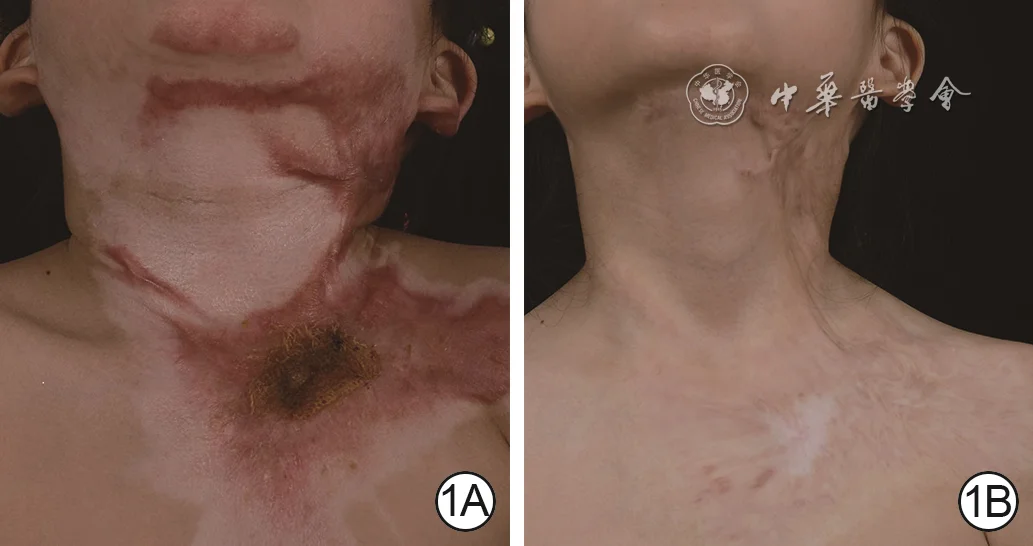
Early red hypertrophic scald scars of the chin, neck, and anterior chest were treated with pulsed dye laser and ultrapulsed fractional carbon dioxide laser combined with multipoint microinjection of triamcinolone; scar thickness, color, and neck traction were markedly improved six months after the final treatment.
- 1ABefore the first combined treatment, the scars are red and uneven, with evident traction across the neck.
- 1BSix months after the final combined treatment, the scars are flat and close to the surrounding skin color, with marked relief of neck traction.
Image source:Lei Y, Tan J, Ouyang HW, et al. Effects of composite laser technique combined with multipoint microinjection of triamcinolone acetonide in the treatment of hypertrophic scars in burn children. Chin J Burns Wounds. 2022;38(9):810–815. DOI: 10.3760/cma.j.cn501225-20220519-00192
 View full-size image
Pediatric facial follow-up
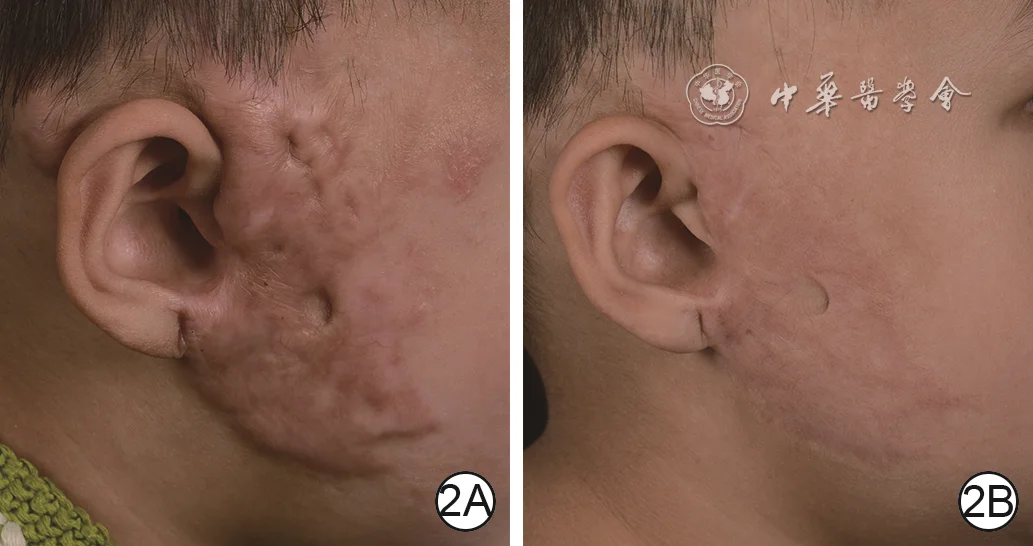
An early red hypertrophic scald scar in the right preauricular region was treated with pulsed dye laser and ultrapulsed fractional carbon dioxide laser combined with multipoint microinjection of triamcinolone; scar contour and color were markedly improved six months after the final treatment.
- 2ABefore the first combined treatment, the right preauricular scar is red, thickened, and uneven.
- 2BSix months after the final combined treatment, the scar is flat and its color approaches the surrounding normal skin.
Image source:Lei Y, Tan J, Ouyang HW, et al. Effects of composite laser technique combined with multipoint microinjection of triamcinolone acetonide in the treatment of hypertrophic scars in burn children. Chin J Burns Wounds. 2022;38(9):810–815. DOI: 10.3760/cma.j.cn501225-20220519-00192
Intralesional scar injections are often used for scars with marked hypertrophy, high firmness, and obvious itching or pain. Commonly used medications include glucocorticoids and other combination medications, with the aim of suppressing fibroblast activity and reducing excessive collagen deposition.
Treatments such as radiofrequency, microneedling, and fractional laser can promote scar remodeling and improve the thickness, texture, and elasticity of some superficial-to-mid-depth scars. For deep contractures, skin defects, or joint dysfunction, energy-based treatments usually need to be combined with surgery and rehabilitation.
These treatments usually need to be performed multiple times. The intervals and parameters should be adjusted by the doctor according to scar thickness, color, location, skin tone, and response.
When Burn Scar Reconstruction Is Needed
Burn scar reconstruction is mainly used when appearance is severely affected, function is limited, scars repeatedly break down, or conservative treatment has not been sufficiently effective.
Common situations requiring reconstruction include: neck scars that limit lifting or turning the head; armpit scars that prevent the arm from being raised high; hand scars that affect making a fist, extending the fingers, or opening the thumb web space; elbow or knee scars that affect bending and straightening; eyelid scars that cause incomplete eye closure or ectropion; perioral scars that cause difficulty opening the mouth; large scars that affect quality of life; long-term scar ulceration or suspected malignant transformation; and so on.
The reconstruction plan should be selected according to scar location, area, depth, surrounding skin conditions, functional needs, and the patient’s age.
Mild band-like contractures may be treated with Z-plasty or local flaps; skin grafting may be needed after release of large areas of scar; flap reconstruction may be required in important functional areas; complex defects may require tissue expansion or microsurgical free flaps.
The Role of Split-Thickness/Full-Thickness Skin Grafting
Skin grafting is often used to cover wounds after release of burn scars. For example, after release of a contracture near a joint, if the skin defect is large and cannot be closed directly, skin grafting may be required.
Thin split-thickness skin grafts are more likely to take and are suitable for larger wound areas; full-thickness skin grafts have better texture and relatively less late contraction, making them suitable for small areas with high texture requirements, such as the face and hands. Skin grafting can cover the wound and restore skin continuity, but the transplanted skin may have differences in color and texture and a risk of recurrent contraction.
Therefore, pressure therapy, splinting, and rehabilitation training are still needed after skin grafting. For areas such as joints, the hands, and the neck, postoperative management also directly affects functional recovery.
The Role of Flaps and Tissue Expansion
Flap reconstruction is suitable for areas with higher requirements for thickness, elasticity, blood supply, and resistance to wear, because flaps have their own blood supply and the tissue quality is usually better than that of a skin graft alone. Flap reconstruction often needs to be considered for areas with high functional and cosmetic demands, such as the hands, feet and ankles, areas around joints, and the face and neck.
 View full-size image
Microsurgical reconstruction
A left medial plantar free flap was used to reconstruct an electrical burn wound of the left palm; at six months, the palmar flap had a favorable contour and the plantar donor site showed no evident scar contracture.
- 1ABefore surgery, the left palmar electrical burn wound contains leathery necrotic tissue.
- 1BThe flap harvest area is designed on the left medial plantar region according to the wound size after debridement.
- 1CAt six months, the flap on the left palm has a favorable contour.
- 1DAt six months, no evident scar contracture is present at the left plantar donor site.
Image source:Han F, Yang XK, He T, et al. Curative effects of medial plantar free flap in reconstructing electric burn wound and scar contracture in the palm. Chin J Burns Wounds. 2023;39(9):820–825. DOI: 10.3760/cma.j.cn501225-20230601-00197
Local flaps can use nearby similar skin to repair small to medium-sized defects. Regional flaps and distant flaps are suitable for larger or deeper defects. Microsurgical free flaps are used for severe and complex burn scars, especially when local tissue conditions are poor after multiple operations, deep structures are exposed, or a large area of stable coverage is needed.
Tissue expansion is suitable for some stable-phase scar repairs. The doctor places an expander near the scar, gradually expands normal skin, and then uses the expanded skin to repair the scarred area. Its advantage is that the color and texture are closer to the surrounding skin, so it is often used on the scalp, face and neck, and trunk. Its disadvantages are that the process is long, requires multiple follow-up visits, and may affect appearance and daily life during expansion.
Long-Term Follow-Up of Burn Scars in Children
Children’s bodies are constantly growing, while scar tissue has poor elasticity and cannot stretch in step with normal skin. Therefore, a scar that was originally mild may gradually become a noticeable tether as height and limb length increase.
After burns involving children’s hands, neck, axillae, or areas near the elbow and knee joints, range of motion, posture, limb development, and daily function should be assessed regularly, so that the impact on future growth can be considered in advance.
Rehabilitation training, pressure garments, splints, and staged surgery when necessary are important components of burn scar management in children. Parents need to watch whether the child avoids certain movements, such as being unwilling to raise an arm, unwilling to extend the fingers, changes in walking posture, or abnormal head and neck posture. If abnormalities are found, medical care should be sought as soon as possible.
Psychological and Quality-of-Life Management of Burn Scars
Burn scars may have long-term effects on appearance, sleep, social interaction, work, and psychological well-being. Scars on exposed areas such as the face, neck, and hands can easily lead to low self-esteem, anxiety, and avoidance of social contact. Itching and pain may also affect sleep, further reducing quality of life.
Psychological support is very important in long-term management. Patients need to understand that improvement in burn scars is often gradual and may not fully restore the skin to its pre-injury state, but comprehensive treatment can significantly improve appearance, comfort, and function. For patients with severe burns, psychological counseling, peer support, vocational rehabilitation, and family support may all help restore confidence in daily life.
Key Points in Daily Care
Daily care of burn scars focuses on cleaning, moisturizing, sun protection, prevention of friction, and prevention of skin breakdown. When the skin is dry, moisturizing should be done regularly, and washing with very hot water should be avoided. Clothing should be soft and breathable to reduce friction over the scarred area. After exercise and stretching, the skin should be checked for any breakdown.
The scarred area may have reduced sensation or may be overly sensitive. People with reduced sensation should avoid burns, frostbite, and excessive friction; people with sensitive skin may undergo desensitization training under a doctor’s guidance.
If a scar suddenly becomes harder, thicker, or more painful, develops ulceration or bleeding, does not heal for a prolonged period, or shows abnormal growth in a longstanding scar, seek medical evaluation promptly.
References
- New Scarology, edited by Huiyuan Li, Kaihua Lu, and Shuzhong Guo, Fourth Military Medical University Press.
- Monstrey S, et al. Updated scar management practical guidelines: non-invasive and invasive measures. J Plast Reconstr Aesthet Surg. 2014;67(8):1017–1025. PubMed
- Gold MH, et al. Updated international clinical recommendations on scar management: part 2—algorithms for scar prevention and treatment. Dermatol Surg. 2014;40(8):825–831. PubMed
- Zeng Y, Wang C, Lin HY, et al. Clinical efficacy of pressure therapy combined with narrow-band intense pulsed light for hypertrophic scars. Chin J Burns Wounds. 2026;42(4):324–331. DOI: 10.3760/cma.j.cn501225-20251211-00518
- Han F, Yang XK, He T, et al. Curative effects of medial plantar free flap in reconstructing electric burn wound and scar contracture in the palm. Chin J Burns Wounds. 2023;39(9):820–825. DOI: 10.3760/cma.j.cn501225-20230601-00197
- Lei Y, Tan J, Ouyang HW, et al. Effects of composite laser technique combined with multipoint microinjection of triamcinolone acetonide in the treatment of hypertrophic scars in burn children. Chin J Burns Wounds. 2022;38(9):810–815. DOI: 10.3760/cma.j.cn501225-20220519-00192